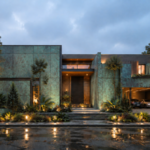
A beautifully resolved interior can still lose its impact at the door. Large doors, pivot doors and full-height entrances occupy significant visual space, yet they are often treated as functional elements, painted or finished to blend into the background. For architects and interior designers working with carefully considered material palettes, this can leave one important surface underdesigned. Liquid metal door skins offer another possibility. Instead of replacing the door or settling for a conventional finish, an existing or newly fabricated door can become a surface in its own right, bringing material, texture, colour and patina into the design.

At Evolve Artisanal, we create bespoke liquid metal door skins and door panels that allow the visible surface to be developed around the architecture and interior, rather than selected from a standard catalogue. Because sometimes, the door isn’t the element that needs changing. It’s the surface that needs rethinking. One way to do that is by rethinking the visible face of the door and this is where a door skin comes in.
What Is a Door Skin?
A door skin is a decorative panel that is applied on the face of a door to give it a statement look while allowing the underlying door structure to remain focused on its function, hardware and performance while the surface becomes part of the interior design. For architects and interior designers, this separation creates greater freedom. Instead of choosing from conventional door finishes, the surface can be developed specifically around the project’s material palette, colour, texture and design language.
At Evolve Artisanal, we bring this approach to life through liquid metal door panels created specifically for the project. Rather than simply designing with a mass produced laminate or finishing with faux metal, these door skins give the entrance its own depth and character, thus making it a focal point that catches attention.
Depending on the design intent, Evolve door panels can be developed in:
- Brass, bronze, copper and iron tones
- Gunmetal and darker metallic expressions
- Oxidised and patinated finishes
- Textured or directional surfaces
- Tonal and ombré variations
- Refined contemporary finishes
The result is a door surface that can be specified as a material in its own right, rather than treated as just another door finish.

Why Specify a Designer Door Skin?
The entrance door can occupy a surprisingly large amount of visual space. Yet conventional doors are often selected from a relatively limited range of laminates, veneers, paints or factory finishes. In a highly customised residence, this can leave the door looking disconnected from the material richness around it.
A bespoke door skin approaches the problem differently. Instead of asking:
Will this door fit in with the interior?
the designer can ask:
What surface should this door have?
That shift opens up possibilities for colour, texture, metal finishes, patina and visual continuity. Three major reasons why modern home should adapt door skins are:
1. Make the door part of the material palette
A door skin can be developed to relate directly to the materials surrounding it.
A bronze-toned surface might echo the home’s hardware and lighting. A textured brass finish could complement warm stone. A dark iron or gunmetal surface could sit alongside timber, marble or plaster.
The objective is not simply to make the door more decorative. It is to make the door belong to the overall design.
2. Create a bespoke surface without redesigning the entire door
Because the decorative surface is separate from the underlying door structure, a designer can focus on the visible face of the door while the underlying construction is resolved according to the project’s requirements.
This can be particularly useful when working with existing doors or project-specific door systems.
3. Introduce rich metal character
Liquid metal finishes offer something different from metallic laminates or printed surfaces.
Actual metal particles within the finish create a surface with metal depth and variation. Through hand application and finishing, the appearance can be developed from relatively uniform and refined to more textured, aged or patinated.
On a large door surface, these subtle variations become part of the visual experience.

Designer Door Skins vs Conventional Door Finishes
For luxury projects, the difference is often less about function and more about what the visible surface can contribute to the design.
| Conventional Door Finish | Designer Liquid Metal Door Skin | |
| Surface | Paint, laminate, veneer or standard finish | Bespoke decorative panel |
| Design | Selected from available options | Developed around the project |
| Metal effects | Usually simulated or standardised | 100% real with qualities of natural metals |
| Texture | Typically selected from existing options | Can be developed as part of the surface |
| Colour | Selected from a fixed palette | Can be customised |
| Patina | Limited | Can be intentionally developed |
| Scale | Dependent on standard product | Developed around the door surface |
| Material continuity | May be limited | Can be coordinated with other architectural surfaces |
| Approach | Product-led | Project-led |
The point is not that every door needs to become a statement piece.It is that when a door does need to make a design contribution, its surface does not have to be limited to a standard catalogue finish.

Where Can Designer Door Skins Be Used?
Designer door skins can be used wherever the visible face of a door plays an important role in the interior or architectural composition.
Residential Entrance Doors
The entrance is often the first opportunity to introduce the material language of a residence. A bespoke metal door skin can bring that language onto the door while allowing the underlying construction to remain project-specific.

Pivot Doors
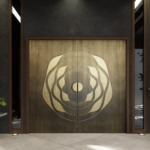
Large pivot doors provide a generous uninterrupted surface for a designer door skin. Liquid metal finishes can be developed across the face of the panel, with texture and tonal movement becoming more apparent as light changes across the surface.
The structural pivot mechanism remains part of the door system; the door skin is the bespoke visible surface applied to it.

Double Doors
For double entrance doors, the two panels can be designed as a single visual composition. Texture, pattern, tonal direction and finish can be coordinated across both surfaces rather than treating each door independently.

Apartment Entrance Doors
Designer door skins are not limited to large villas. They can also be used for apartment entrance doors where the foyer or surrounding interior calls for a more considered surface.

Interior Doors
A door skin can also be used away from the main entrance. Studies, libraries, home theatres, dressing rooms, wine rooms and primary-suite entrances can all become opportunities for a bespoke surface.
This can be particularly effective when a related metal finish appears elsewhere in the residence.

Hospitality and Commercial Interiors
Hotels, private clubs, restaurants, branded residences and luxury retail environments can use designer door skins to create considered surfaces without requiring every door to be fabricated entirely as a metal door.

Where the Finish Shapes the Design
The finish gives a door skin its character. The choice of metal, tone and surface finish can influence how the door sits within the overall interior.
Brass – Warm and luminous, brass works particularly well with natural stone, warm timber, soft neutrals and other metal detailing.
Bronze – Deeper and more understated than bright brass, bronze can introduce richness and warmth while working comfortably within contemporary interiors.
Copper – Copper brings warmth to a space and can be developed with varied or aged tonal character, from relatively even surfaces to more expressive patinated finishes.
Iron and Gunmetal – Darker metal finishes offer a restrained contemporary expression and can work effectively against pale stone, plaster, concrete and timber.
Patinated Finishes – Patination introduces variation and an aged quality to the surface. Depending on the desired result, this can range from subtle tonal movement to a more expressive oxidised appearance.
Textured Finishes – Texture can influence how light moves across the door skin. Linear marks, directional surfaces, relief and other effects can give a large panel greater depth without relying on pattern alone.

Developing the Door Surface
At Evolve Artisanal, we are experts in developing the designer metal door skin to suit the character of the project rather than selecting from a fixed range of finishes. Depending on the design direction, the surface can be considered through:
- Metal tone
- Color
- Texture
- Patina
- Surface direction
- Pattern or relief
We specialise in crafting bespoke designer door skins using liquid metal, textured concrete and corten steel for interior and architectural surfaces. Each skin is developed as part of the wider design language, allowing the door to carry the same material depth, pattern, or patina found across the project
What Architects Should Consider Before Specifying a Door Skin
A successful designer door skin starts with the door itself.
1. Existing Door and Substrate
The existing or proposed door needs to be suitable for receiving the decorative panel. The substrate, build-up and installation method should therefore be considered before the surface is finalised.
2. Door Dimensions
Share the door elevation and dimensions early. Large-format or unusually proportioned doors may require specific consideration of weight, fixing and construction.
3. Interior or Exterior Application
Where the door skin is being used matters. Interior applications and exposed entrance applications can have different requirements for substrate, protection, detailing and maintenance.
4. Hardware
Handles, locks and other hardware should be coordinated with the door skin. Their position and finish should be considered alongside the overall surface composition.
5. Edges and Junctions
The face of the door is only one part of the detail. How the skin terminates at the edges, meets the frame and interacts with reveals or adjacent surfaces should be resolved during design development.
6. Finish Samples
Metal finishes can change considerably depending on lighting and surrounding materials. A physical sample should ideally be evaluated alongside the project’s stone, timber, wall finish, hardware and lighting before the finish is approved.
7. Protection and Maintenance
The protective system should be appropriate to the chosen finish and application. Expected appearance, environmental exposure, cleaning requirements and maintenance should be established before fabrication.

When the Surface Starts With the Design
At Evolve Artisanal, we craft bespoke luxury panels, handcrafted panels, and unique panels that anchor the material palette of a home. Liquid metal finishes are becoming far more than decorative paint effects, evolving into sophisticated architectural wall concepts rooted in craftsmanship, artistry, and material innovation. As manufacturers of artisanal wall panels and designer door skins, we develop surfaces that bring depth, character and a considered material expression to a space.

Frequently Asked Questions About Designer Door Skins
Does Evolve Artisanal manufacture complete doors?
No. At Evolve, we do not sell or manufacture complete door units. We specialise in crafting designer door skins, bespoke metal panels and special finishes, which can be installed on an existing or a new door.
Can a door skin be installed on an existing door?
It can be, depending on the door’s construction, dimensions, substrate and hardware.
Can designer door skins be made for pivot doors?
Yes. We develop custom door skins for pivot doors and other large-format doors, working around the requirements of the underlying door system, dimensions and hardware.
Can designer door skins be customised?
Yes. We can customize the size, metal tone, design, and overall surface character to work with the project’s design direction and material palette.
What finishes are available for metal door panels?
At Evolve, we work with brass, bronze, copper, aluminium, iron and gunmetal, including patinated, oxidised, textured and ombré finishes.
Can designer door skins be used for luxury villas?
Yes. Bespoke door skins work across villa entrances, apartment entrances and interior doors, particularly where the door forms part of the wider architectural and interior design.
Where does Evolve Artisanal work?
Based in Mumbai, we at Evolve develop bespoke metal panels and special finishes for residential, hospitality and commercial projects across India and international markets. Our work has been shipped to projects across the USA, UK, Europe, the Middle East, Singapore and Malaysia.
Give the Door a Surface Worth Looking At
A door does not need to be manufactured entirely from metal to become a powerful material element. Sometimes, the opportunity is the surface. A bespoke designer door skin allows an existing or newly fabricated door to become part of the architectural language of the space through material, texture, colour and craftsmanship. With liquid metal, that surface can take on the depth and character of brass, bronze, copper, iron or other metal finishes, with textures and patinas developed around the project.
At Evolve Artisanal, we specialize in crafting bespoke art panels and designer door skins for residential, hospitality and commercial spaces. We work with architects and interior designers to develop the visible surface around the requirements of each project. If you are working on a project where the door surface deserves more than a standard finish, share your door elevation, dimensions, drawings, moodboard or material references with our studio. We can help explore the right surface, finish and panel solution for the space. Connect with us at +91 9372862239 or email us at [email protected] to discuss your project.
Author
Written by the Evolve Artisanal Materials Team—specialists in handcrafted architectural surfaces, luxury special finishes, and bespoke material applications for residential, hospitality, and commercial environments across India, the Middle East, Europe, and North America.