Luxury interiors have become increasingly sophisticated. Clients are more travelled, more visually literate, and often quicker to recognise the difference between a space that feels genuinely considered and one that simply photographs well. As a result, materiality is carrying more weight than ever, and in many of the most resolved projects, handcrafted metal surfaces are beginning to occupy a role that conventional finishes cannot.
At Evolve Artisanal, we work at precisely this intersection, creating bespoke liquid metal panels and special finishes that bring material depth, tonal movement, and lasting atmosphere to luxury residential and hospitality spaces.
Why Designers Are Moving Beyond Decorative Wall Finishes
Wallpaper, stone, timber, plaster, and textiles all have their place. But certain projects call for something more immersive: a surface that shifts with light, feels materially alive, and contributes to how a room is experienced over time rather than simply how it looks at handover.

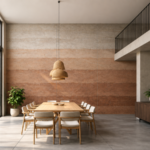
This is where handcrafted metal begins to feel categorically different. Unlike printed or reproduced finishes, metal panels possess tonal movement and depth that come directly from the material itself. Copper warms as daylight changes. Bronze reveals its subtleties gradually, across distance and time. Iron patina grounds a room with an understated richness that reads as part of the architecture rather than something applied to it.
The experience is difficult to replicate because it is not an effect. It is the material. For designers working on spaces intended to feel singular, a residence, boutique hotel, wellness retreat, or hospitality concept, this distinction matters. Because no two handcrafted panels develop in exactly the same way, every installation carries its own visual character and relationship to the surrounding space.
Where Metal Panels Work Best
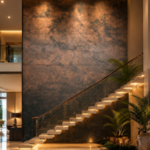
Consider a curved corridor finished in softly oxidised copper: as guests move through it, the surface shifts, tonal, alive, impossible to fully take in from a single vantage point. Or a double-height feature wall that introduces depth and quiet drama without relying on overt ornamentation. Or a powder room wrapped in textured metal, where the material’s density creates a sense of immersion that paint or wallpaper simply cannot approach.

What these applications share is that the surface stops reading as something added to the room and starts feeling intrinsic to it. In hospitality and high-end residential projects especially, this ability to work across unusual forms, curved walls, expansive volumes, and architecturally complex transitions often becomes the design opportunity itself.
Why Patina Changes the Conversation
Most decorative finishes are designed to look their best at the moment of installation. Handcrafted metal behaves differently.
Patina develops. Tonal shifts become more nuanced. The interplay of texture, oxidation, and light gains complexity as a project matures, often giving the material greater presence and character over time. For designers creating spaces intended to age gracefully rather than date quickly, this quality is particularly compelling.

What is worth understanding is that patina is not unpredictability. Decisions around oxidation levels, tonal direction, texture, and movement are considered carefully in relation to the architecture, lighting conditions, and emotional atmosphere of the space. The surface is designed to evolve, but its direction is intentional from the outset.
Using Metal to Shape Atmosphere
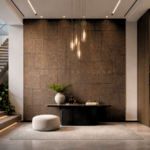
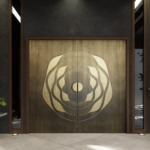
In a hospitality lobby, a deeply layered bronze or iron surface can create a sense of permanence and quiet drama that faster finishes rarely achieve. In a residence, softly textured brass introduces warmth without visual heaviness. Used selectively, behind a bed backdrop, within a private lounge, around a bar front, or as part of a sculptural architectural moment, metal surfaces can establish mood in ways that go well beyond finishing a room.

There are no fixed rules. The material offers another register of expression for spaces where individuality matters. And in an environment where clients increasingly seek interiors that feel personal rather than repeated, that flexibility is genuinely valuable.
When Bespoke Metal Panels Make Sense
Handcrafted metal surfaces sit in a different category from standard decorative finishes, both materially and in terms of what they are solving for. Rather than a replaceable finish, they are often considered part of the long-term identity of a space: developed around a specific brief, shaped by material choice, and carrying a character that cannot be replicated elsewhere.

For designers balancing longevity, originality, and client expectations around craftsmanship, this shifts the conversation from short-term cost to long-term value.
Why Material Conversations Should Begin Early
One thing designers consistently find when working with bespoke metal surfaces is that the best outcomes happen when material thinking begins early. Curvature, lighting, panel scale, transitions, and spatial continuity all shape how a handcrafted surface ultimately performs within the architecture. When integrated from the start rather than resolved at the end, the result feels seamless, less like an installation, more like something the space could not exist without.

At Evolve Artisanal, every handcrafted metal art panel is developed around the realities of the project: its scale, atmosphere, materiality, and architectural intent. From expressive patinas to textured liquid metal finishes, each surface is a bespoke response to a specific brief rather than a catalogue product adapted to fit.
Our work spans luxury residences, hospitality projects, boutique commercial spaces, and branded environments across the UK, UAE, and India. A surface that continues to deepen and reward attention long after installation – that is what distinguishes a finish from a material decision. If you are working on a project where that distinction matters, we would welcome the conversation. Reach out to our studio to begin.